



Dissociation, DID, and complex trauma
Counseling for dissociation, DID, and complex trauma
Lost time, feeling unreal, or parts of you that seem to act on their own are not signs that you are broken. They are signs of a mind that found a way to survive. Specialized care can help those parts work together.
Request a consultationPrivate telehealth counseling for residents of Georgia, Florida, and Virginia.
Does this sound familiar?
Many people with dissociation spend years in treatment before anyone names what is happening. You may notice:
- Gaps in memory for everyday events, or finding things you do not remember doing
- Feeling detached from your body, your emotions, or the world around you
- Hearing inner voices, or sensing parts of yourself with different ages, feelings, or preferences
- Shifts in skills, habits, or how you see yourself that others notice
- A history of overwhelming experiences, often beginning in childhood
Dissociation exists on a continuum, from everyday daydreaming to Dissociative Identity Disorder, or DID (American Psychiatric Association [APA], 2022).
Your mind did something brilliant

When a child faces something they cannot escape and cannot make sense of, the mind can set the experience aside so life can go on. Dr. Darleen calls this a Human Super Power™: a protective response that made sense at the time it formed.
The goal is not to fight the parts that protected you. It is to help every part discover that it is safe now.
Looking at dissociation this way reduces shame, and that alone often makes treatment possible (Saleebey, 1996).
How Dr. Darleen helps

Dr. Darleen specializes in dissociative disorders and borderline personality disorder. Her care follows the phase-oriented approach recommended by international expert guidelines (International Society for the Study of Trauma and Dissociation [ISSTD], 2011; Herman, 1992):
- Safety and stabilization first. Building daily stability, grounding, and calm before any work with painful memories.
- Respect for every part. Learning to communicate and cooperate inside, at a pace your system can tolerate.
- Body-based regulation. Breath, movement, and calming practices that work with your nervous system, drawn from her Fluid Trauma™ framework.
- Careful assessment. Dissociation is often mistaken for other conditions. An accurate picture leads to the right care.
What sessions look like
Meet from home, wherever you are in Georgia, Florida, and Virginia.
A full counseling hour, without the commute.
Usually weekly, on a schedule we set together.
We go at a pace your mind and body can handle.
A real reason for hope

In a study of people with dissociative disorders treated by community clinicians, patients showed improvements in symptoms and daily functioning over 30 months, along with fewer self-harm behaviors and hospitalizations (Brand et al., 2013).
Healing does not mean losing yourself. It means feeling more whole, more present, and more in charge of your own life.
Meet Dr. Darleen
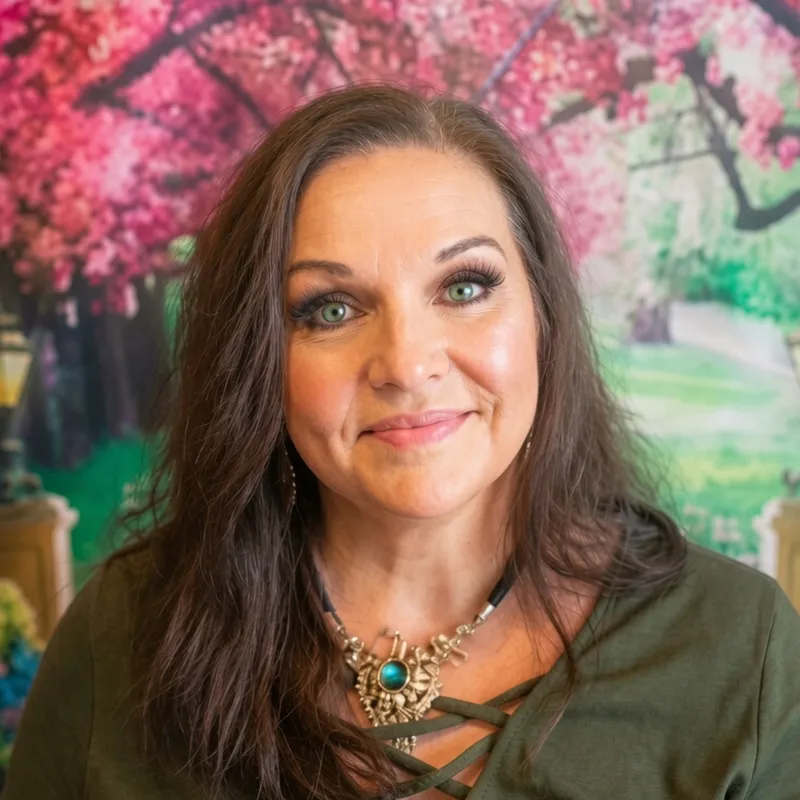
Dr. Darleen Claire Wodzenski, MS ESE, MA CMHC, PhD, LPC, NCC, ACS, is the Clinical Director of Orchard Human Services, Inc. She is a Licensed Professional Counselor in Georgia, Florida, and Virginia, a Nationally Certified Counselor, and an Approved Clinical Supervisor who trains other counselors. Before becoming a counselor, she taught piano and dance, taught general and special education, served as a special education director, and worked as a graduate tutor and faculty member.
For more than thirty years, Dr. Darleen has taught and cared for people of all ages: as a piano and dance teacher, a general and special education teacher, a graduate tutor and faculty member, and a counselor and clinical supervisor. Her clinical work includes adults and children who have survived overwhelming experiences, including children removed from their homes because of abuse. She developed the Fluid Trauma™ and Human Super Power™ frameworks, which emphasize pacing, safety, and respect for the adaptations that helped a person survive.
Private self-pay counseling
You pay the full session rate directly. Paying privately means no insurance record of your diagnosis or treatment. Sessions are by secure telehealth, so you can meet from home anywhere in Georgia, Florida, and Virginia.
Why private pay?
No claim is filed, so no insurance record of your diagnosis or treatment.
You and Dr. Darleen decide the focus and pace of care, not an insurer.
No insurer caps on how many sessions you can have.
Fees change only on January 1, with advance notice. You will receive a Good Faith Estimate of expected costs before your first appointment.
Take the first step
Planning to use insurance? Please use our Appointments page instead.
Questions first? Email DrDarleen@orchardhumanservices.org.
This page is for general information and is not a diagnosis or treatment. If you are in crisis, call or text 988 or call 911. See our crisis resources.
Not ready to book yet?
Start with the free guide
The Brilliance Within: Discovering Your Human Super Power™ is Dr. Darleen’s strength-based guide to healing for individuals and families. It covers trauma, dissociation, BPD, attachment, autism, and the tools that help people grow.
Get the free guideCommon questions
How much does it cost?
How soon can I start?
Where do sessions happen?
Do I need a diagnosis first?
Does Dr. Darleen prescribe medication?
What if I am in crisis?
References
American Psychiatric Association. (2022). Diagnostic and statistical manual of mental disorders (5th ed., text rev.). https://doi.org/10.1176/appi.books.9780890425787
Brand, B. L., McNary, S. W., Myrick, A. C., Classen, C. C., Lanius, R., Loewenstein, R. J., Pain, C., & Putnam, F. W. (2013). A longitudinal naturalistic study of patients with dissociative disorders treated by community clinicians. Psychological Trauma: Theory, Research, Practice, and Policy, 5(4), 301–308. https://doi.org/10.1037/a0027654
Herman, J. L. (1992). Trauma and recovery. Basic Books.
International Society for the Study of Trauma and Dissociation. (2011). Guidelines for treating dissociative identity disorder in adults, third revision. Journal of Trauma & Dissociation, 12(2), 115–187. https://doi.org/10.1080/15299732.2011.537247
Saleebey, D. (1996). The strengths perspective in social work practice: Extensions and cautions. Social Work, 41(3), 296–305. https://doi.org/10.1093/sw/41.3.296
Orchard Human Services, Inc. is an IRS-approved 501(c)(3) nonprofit organization. 4813 Ridge Road, Suite 111-83, Douglasville, GA 30134.