




Moving Toward Whole Foodsand finding the balance that fits you
Most nutrition advice arrives as a rule everyone is supposed to follow. But people respond to the same meal in genuinely different ways — and the research now shows this clearly.
This page explains what whole foods means, what the three macronutrients actually do, and how to find your balance by paying attention rather than by following someone else’s numbers.
Read-aloud is not available in this browser. Chrome, Edge, and Safari support it.
What “whole foods” actually means
A whole food is one you would recognize as having come from somewhere. An apple. A chicken thigh. Rolled oats. A handful of walnuts. A sweet potato. It may have been cooked, chopped, frozen, or dried — that is fine. What it has not been is taken apart and rebuilt.
The contrast is with ultra-processed food: products made largely from substances extracted from foods, plus additives that do not appear in a home kitchen — protein isolates, modified starches, emulsifiers, flavour compounds, colourings (Monteiro et al., 2019).
This is not about willpower or virtue. It turns out the difference has a measurable effect on how much people eat without deciding to.



None of this is deprivation food. Whole food is mostly just — food.
The same calories, offered two ways
Hall and colleagues (2019) housed twenty adults in a research facility for four weeks. Each person spent two weeks eating ultra-processed meals and two weeks eating minimally processed meals. The two diets were matched for calories, sugar, fat, fibre, and macronutrients. Participants could eat as much or as little as they liked.
On the ultra-processed diet, people ate about 500 more calories per day and gained weight. On the minimally processed diet, they ate less and lost weight. Nobody was told to eat differently. They simply did.
This is one of very few tightly controlled feeding trials in nutrition, and it suggests something useful: the form food takes changes how much of it you want. That is a much kinder starting point than assuming the problem is discipline.
Eat the rainbow — and why it is not just a slogan
The colour in a plant is not decoration. Those pigments are compounds the plant makes to protect itself — and eating a wide range of them appears to be one of the more reliable things you can do for your health (Reynolds et al., 2019).
Different colours mean different compounds. So a plate with four colours on it is doing something a plate with one colour cannot, however healthy that one thing is.



Count colours, not calories
At your next meal, count how many colours are on the plate. Two is common. Three is good. Four or more and you are almost certainly eating well, whatever the macronutrient split happens to be.
It is a far easier habit than tracking, it requires no app, and it moves the thing that most reliably matters — variety.
The three macronutrients
“Macros” is short for macronutrients — the three things food is made of that your body uses in large amounts. Everything you eat is some combination of these three.
Protein
Building material. Muscle, enzymes, neurotransmitters, immune cells, repair. It is also the most filling of the three — protein at a meal reliably reduces how hungry you are afterward (Leidy et al., 2015).
Whole food sources: eggs, fish, poultry, meat, dairy, legumes, tofu, nuts, seeds.
Carbohydrate
Quick fuel. What matters more than the amount is the form. Carbohydrate arriving with fibre intact behaves very differently from carbohydrate stripped of it — higher fibre intake is consistently associated with better health outcomes (Reynolds et al., 2019).
Whole food sources: vegetables, fruit, beans, whole grains, potatoes.
Fat
Structure and steadiness. Every cell membrane is built from it, hormones are made from it, and it slows digestion — which is part of why higher-fat meals feel steadier to many people.
Whole food sources: olive oil, avocado, nuts, seeds, fatty fish, eggs, dairy.
And then there is fibre
Fibre is not one of the three. It is technically a carbohydrate, but your body cannot digest it — which is precisely the point. It passes through largely intact, and what it does on the way is most of why plants are good for you.

Long fermentation partly pre-digests the dough before it ever reaches you. Lactic acid bacteria produce enzymes that break down gluten proteins and alpha-amylase trypsin inhibitors, and phytase that releases magnesium, zinc and iron otherwise locked up by phytic acid. Many people with non-celiac wheat sensitivity tolerate it noticeably better.
The bacteria themselves do not survive the oven — so sourdough is not a probiotic food. What survives is what they made: organic acids and other postbiotic compounds that do reach the gut. Strains such as Limosilactobacillus reuteri, found in long warm ferments and well studied for gut health, contribute to that chemistry even though the organisms are gone by the time you slice the loaf.
Sourdough is not safe for celiac disease. Partial breakdown is not elimination.
What it does
- Feeds your gut bacteria. They ferment it into compounds your own cells then use.
- Slows absorption. The same sugar arrives more gently when fibre comes with it.
- Adds bulk and satiety without adding usable calories.
Why it matters here
Fibre is the single thing most reduced when a whole food becomes an ultra-processed one. Strip it out and the same carbohydrate behaves very differently on the way in.
Higher fibre intake is one of the most consistent findings in nutrition research — associated with better outcomes across a wide range of measures (Reynolds et al., 2019).
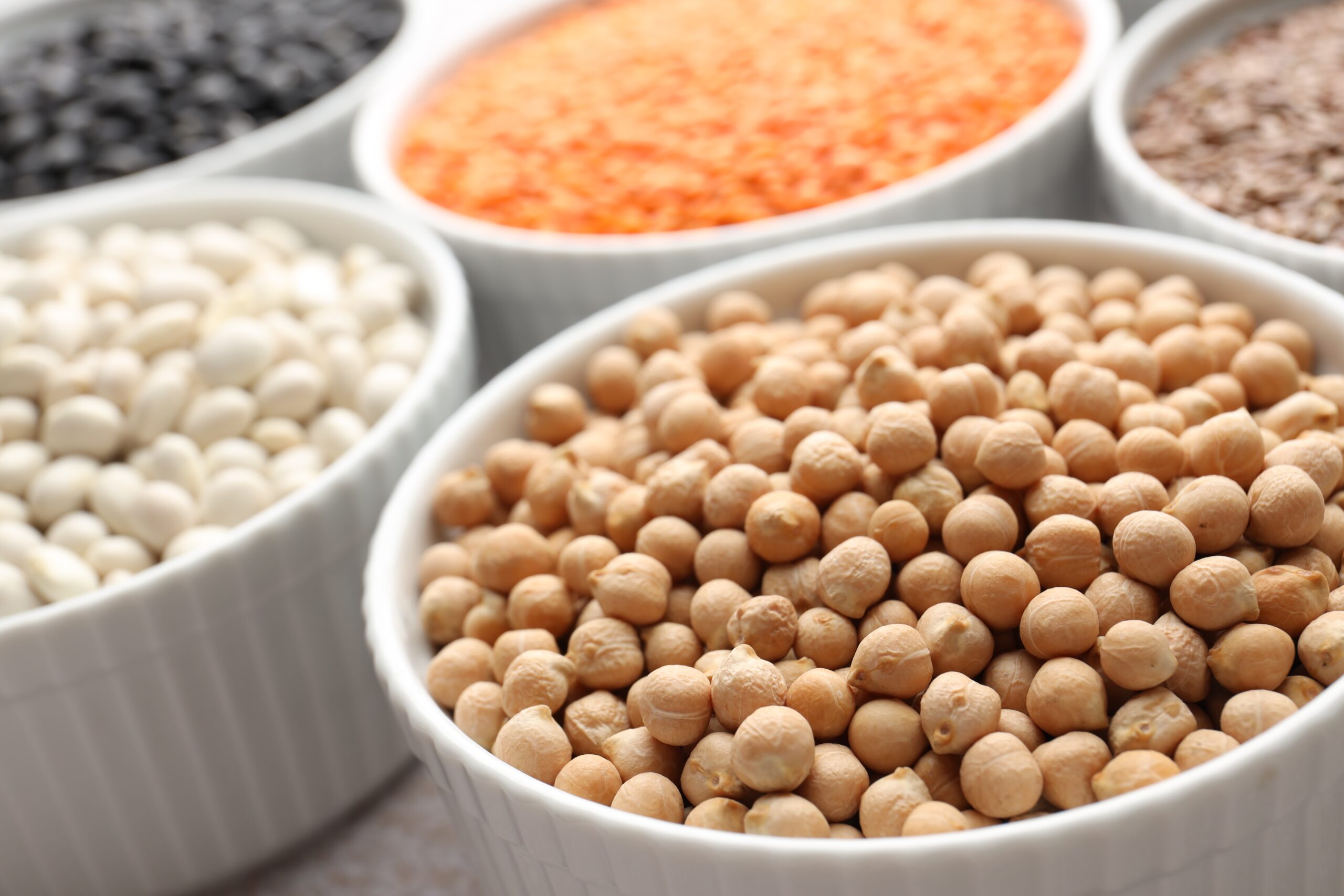
Where to find it: beans and lentils, vegetables, whole grains, fruit eaten with the skin, nuts and seeds.
What different balances look like
People often want a number. Here are four patterns that real people eat, shown as rough percentages of daily calories. None of these is a recommendation. They are here so the idea of “balance” has something concrete attached to it.
For reference, the official ranges considered acceptable for adults are 10–35% protein, 45–65% carbohydrate, and 20–35% fat (Institute of Medicine, 2005). Some of the patterns below sit outside those ranges — which people do, and which is a conversation for your physician or dietitian rather than a website.
Balanced / Mediterranean-leaning
Plants, olive oil, fish, legumes, whole grains. The pattern with the largest body of long-term evidence behind it (Estruch et al., 2018). A reasonable place to start if you have no particular reason to start elsewhere.
Higher protein
Often chosen by people focused on satiety, strength, or preserving muscle with age. Protein is the most filling macronutrient, so some people find this steadies appetite considerably.
Lower carbohydrate, higher fat
Sits outside the standard ranges, and suits some people markedly better than others — particularly those whose blood sugar swings sharply after carbohydrate. This is one to work through with a physician, not to adopt from a webpage.
Higher carbohydrate
Common among people doing a lot of endurance activity, and among many traditional dietary patterns worldwide. Works well for some people and poorly for others.



Three very different balances. All three are whole food. Which one suits you is the question this page cannot answer for you.
The percentages matter less than the sources
A 40% carbohydrate day built from beans, vegetables, and oats is a different day from a 40% carbohydrate day built from crackers and soda — even though the number is identical. Whole food quality does more work than the ratio does. If you only change one thing, change the sources.
Why your balance will not match anyone else’s
This is the part that changes how you should read every diet book you have ever picked up.
Zeevi and colleagues (2015) fitted 800 people with continuous glucose monitors and tracked their responses to nearly 47,000 meals. They found large, consistent differences between individuals eating identical food. One person’s blood sugar would spike on a banana and stay flat on a cookie; the next person’s did the reverse. The authors concluded that universal dietary recommendations may have limited usefulness.
Berry and colleagues (2020) replicated this in over a thousand people, including identical twins, and found the same wide variation in how people handle the same meal — with genetics explaining only part of it.
And Gardner and colleagues (2018) randomised more than 600 adults to a low-fat or a low-carbohydrate diet for a year. On average there was no significant difference between the two. But the individual results ranged from losing a great deal of weight to gaining some — on both diets. The average concealed everything interesting.
There is no diet that is right. There is a diet that is right for you.
If a way of eating worked wonderfully for your sister and did nothing for you, neither of you did anything wrong. You are running different machinery.
Which means the useful question is not what should I eat? It is how do I find out what suits me? That is answerable, and it does not require an expert to tell you — only attention, and a bit of patience.
How to find your own balance
You are looking for patterns, not perfection. Keep notes for two or three weeks and read them back — the pattern is usually obvious in hindsight and invisible in the moment.
What to write down
What patterns look like
- An afternoon crash after certain lunches often points to a carbohydrate load that does not suit you — or to a meal that was light on protein and fat.
- Feeling hungry ninety minutes after eating usually means not enough protein or fat, rather than not enough food.
- Heaviness and fog after a meal may mean too much at once, or a food your system finds hard work.
- Steady energy for four hours is the signal you are looking for. Note what you ate. Do it again.
- Poor sleep after late or heavy dinners is common and easy to miss without written notes.
Change one thing at a time, and give it two weeks
If you change your breakfast, your dinner, and your bedtime in the same week, you will learn nothing about any of them. Change one, hold everything else steady, and watch.
And give each change at least a fortnight. Bodies adjust slowly, and the first few days of any change tell you more about novelty than about fit.

Making the change stick
Overhauls fail. Almost everyone who clears out the whole kitchen on a Sunday is back where they started by the end of the month. Migration works better than revolution.




Yes, cookies. A way of eating that excludes everything you love is a way of eating you will abandon by March — room for what you love is what makes the rest sustainable.
These are built to fit rather than to be resisted: molasses brings iron, calcium and potassium that refined sugar does not, and the protein and fat in the recipe slow everything down so a sweet arrives gently instead of all at once.
Get the recipe →
Nutrition & Health Journal
One page per day. Fill in what is useful to you and leave the rest blank — a half-filled journal you keep is worth more than a complete one you abandon after five days.
Print a stack of them, or download and type into it. Two or three weeks is usually enough to see a pattern.
Nutrition & Health Journal
Downloads as a Word-compatible file you can type into or print. “Print a week” gives you seven copies at once.
- Fill in only what interests you. Most people use three or four lines per meal and ignore the rest.
- The three-hour mark is the one that matters most. If you note nothing else, note that.
- Do not tidy it up. A scribbled “awful, could not focus” is more useful than a neat entry written from memory that evening.
- Read it back weekly, not daily. Patterns show up across days and disappear when you stare at one.
- Bring it to your appointments. Two weeks of notes tells a physician or dietitian more than any answer you can give from memory.
This journal is not for everyone
If you have a history of disordered eating, detailed food tracking can tip into preoccupation and restriction. The weight and portion lines in particular are worth leaving out entirely, or skipping the journal altogether.
There is a version of this that involves no writing at all: eat whole food, notice how you feel, and let that be enough. If the journalling itself starts to feel compulsive or distressing, stop and talk to someone. The National Alliance for Eating Disorders helpline can help you find support.
Blood sugar lines are for people who already have a meter or monitor through their physician. This page is not suggesting you start.
Working with your providers
- You have diabetes, kidney disease, heart disease, thyroid disease, or any condition affecting how you process food. Macro changes can interact with medication, sometimes significantly.
- You are taking medication — particularly for blood sugar or blood pressure, where dietary change can require dose adjustment.
- You are pregnant, breastfeeding, or under eighteen.
- You have a history of disordered eating. See below.
A registered dietitian nutritionist is the right professional for individualised targets. Your physician can order labs and advise on interactions. This page is a starting point for that conversation, not a substitute for it.
Tracking is not for everyone
For some people, keeping food records tips into preoccupation, rigidity, or restriction. If you have a history of disordered eating — or if you notice the journaling itself starting to feel compulsive or distressing — stop, and talk to someone.
There is a version of this work that does not involve writing anything down: eat whole food, notice how you feel, and let that be enough. That is a completely legitimate path, and for some people it is the safer one.
If you are struggling with eating, the National Alliance for Eating Disorders helpline can connect you with support.
A note on my role

I am a Licensed Professional Counselor. I am not a registered dietitian, and I do not prescribe diets or set individual nutrition targets. This page is general health education, not nutrition counselling.
What I do is work with people on the daily rhythms that support mental health — sleep, movement, light, connection, and eating regularly enough that the body has something to work with. When food is part of what a client is sorting out, my role is to help them notice their own patterns and to bring good questions to the professionals who can answer them.
I will say one thing from personal experience, offered as one person’s data point and nothing more: my own balance runs higher in fat than most guidance suggests, and it took years of paying attention to work that out. Yours will be yours. The finding is the work.

What your body is actually doing with all this
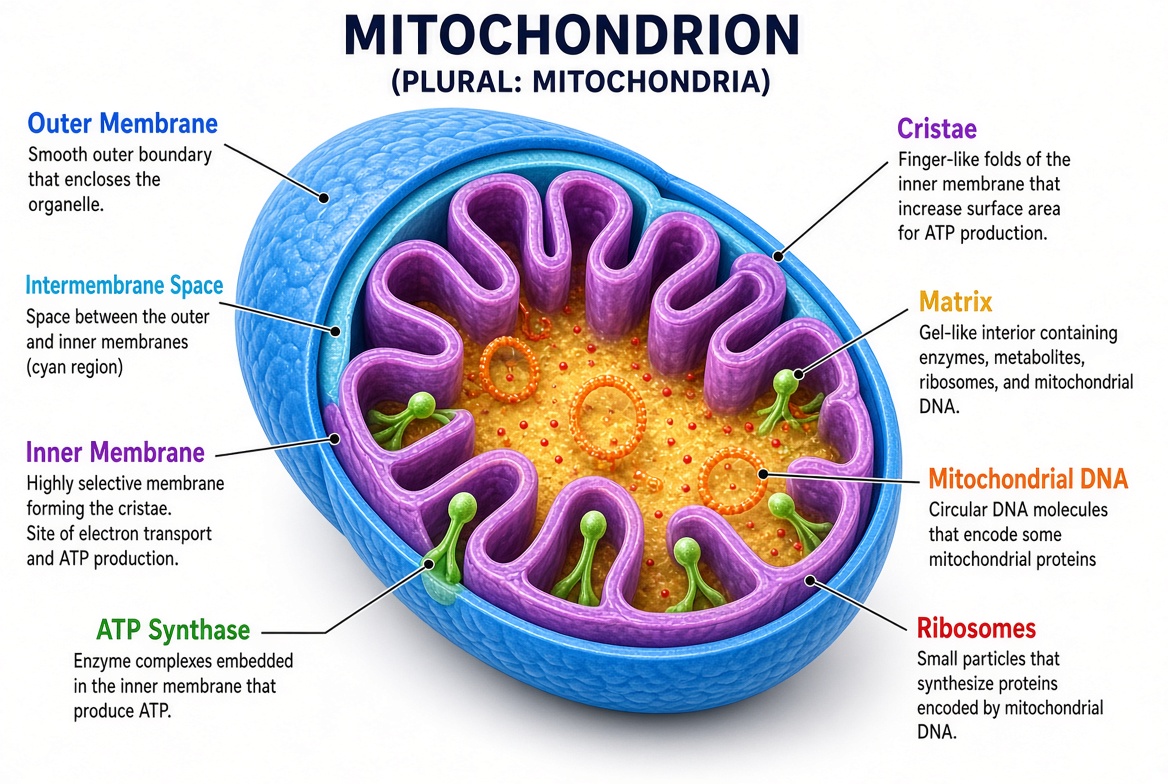
Protein, carbohydrate, and fat are not the destination. They are raw material for something that happens far below anywhere you can feel it.
The other half of this story
If the food you eat is the raw material, mitochondria are the machinery that turns it into usable energy — the energy to walk, talk, think, hug, play, and work. What you eat matters partly because of what they can do with it.
Our companion page explains that side in plain language, along with the other things that support it: sleep, morning light, movement, and rest.
Support for building rhythms that hold
If you would like support in putting daily rhythms in place — and in staying with them past the first enthusiastic fortnight — I would be glad to talk.
Please do not include detailed health information in a text or email, as neither is a secure channel.
References
- Berry, S. E., Valdes, A. M., Drew, D. A., Asnicar, F., Mazidi, M., Wolf, J., Capdevila, J., Hadjigeorgiou, G., Davies, R., Al Khatib, H., Bonnett, C., Ganesh, S., Bakker, E., Hart, D., Mangino, M., Merino, J., Linenberg, I., Wyatt, P., Ordovas, J. M., … Spector, T. D. (2020). Human postprandial responses to food and potential for precision nutrition. Nature Medicine, 26(6), 964–973. https://doi.org/10.1038/s41591-020-0934-0
- Estruch, R., Ros, E., Salas-Salvadó, J., Covas, M.-I., Corella, D., Arós, F., Gómez-Gracia, E., Ruiz-Gutiérrez, V., Fiol, M., Lapetra, J., Lamuela-Raventos, R. M., Serra-Majem, L., Pintó, X., Basora, J., Muñoz, M. A., Sorlí, J. V., Martínez, J. A., & Martínez-González, M. A. (2018). Primary prevention of cardiovascular disease with a Mediterranean diet supplemented with extra-virgin olive oil or nuts. New England Journal of Medicine, 378(25), e34. https://doi.org/10.1056/NEJMoa1800389
- Gardner, C. D., Trepanowski, J. F., Del Gobbo, L. C., Hauser, M. E., Rigdon, J., Ioannidis, J. P. A., Desai, M., & King, A. C. (2018). Effect of low-fat vs low-carbohydrate diet on 12-month weight loss in overweight adults and the association with genotype pattern or insulin secretion: The DIETFITS randomized clinical trial. JAMA, 319(7), 667–679. https://doi.org/10.1001/jama.2018.0245
- Hall, K. D., Ayuketah, A., Brychta, R., Cai, H., Cassimatis, T., Chen, K. Y., Chung, S. T., Costa, E., Courville, A., Darcey, V., Fletcher, L. A., Forde, C. G., Gharib, A. M., Guo, J., Howard, R., Joseph, P. V., McGehee, S., Ouwerkerk, R., Raisinger, K., … Zhou, M. (2019). Ultra-processed diets cause excess calorie intake and weight gain: An inpatient randomized controlled trial of ad libitum food intake. Cell Metabolism, 30(1), 67–77. https://doi.org/10.1016/j.cmet.2019.05.008
- Institute of Medicine. (2005). Dietary reference intakes for energy, carbohydrate, fiber, fat, fatty acids, cholesterol, protein, and amino acids. National Academies Press.
- Leidy, H. J., Clifton, P. M., Astrup, A., Wycherley, T. P., Westerterp-Plantenga, M. S., Luscombe-Marsh, N. D., Woods, S. C., & Mattes, R. D. (2015). The role of protein in weight loss and maintenance. American Journal of Clinical Nutrition, 101(6), 1320S–1329S. https://doi.org/10.3945/ajcn.114.084038
- Monteiro, C. A., Cannon, G., Levy, R. B., Moubarac, J.-C., Louzada, M. L. C., Rauber, F., Khandpur, N., Cediel, G., Neri, D., Martinez-Steele, E., Baraldi, L. G., & Jaime, P. C. (2019). Ultra-processed foods: What they are and how to identify them. Public Health Nutrition, 22(5), 936–941. https://doi.org/10.1017/S1368980018003762
- Reynolds, A., Mann, J., Cummings, J., Winter, N., Mete, E., & Te Morenga, L. (2019). Carbohydrate quality and human health: A series of systematic reviews and meta-analyses. The Lancet, 393(10170), 434–445. https://doi.org/10.1016/S0140-6736(18)31809-9
- Zeevi, D., Korem, T., Zmora, N., Israeli, D., Rothschild, D., Weinberger, A., Ben-Yacov, O., Lador, D., Avnit-Sagi, T., Lotan-Pompan, M., Suez, J., Mahdi, J. A., Matot, E., Malka, G., Kosower, N., Rein, M., Zilberman-Schapira, G., Dohnalová, L., Pevsner-Fischer, M., … Segal, E. (2015). Personalized nutrition by prediction of glycemic responses. Cell, 163(5), 1079–1094. https://doi.org/10.1016/j.cell.2015.11.001
Dr. Darleen Claire Wodzenski, MS ESE, MA CMHC, PhD, LPC, ACS · Orchard Human Services, Inc.
This page is general wellness education. It is not medical or nutrition advice, is not individualized, and is not a substitute for care from your physician or a registered dietitian nutritionist. Licensed professional counselors do not provide medical nutrition therapy. Please consult qualified providers before making significant dietary changes, particularly if you take medication or have a health condition.