



Melanopsin may be the key to understanding how to get the best night’s sleep of your life. Recent advances in sleep research revealed that exposure to blue light may interfere with sleep, circadian rhythm, and mental well-being. Take a deeper dive into these specialized cells in your body to better understand why the human body needs to sleep in the dark.
Click here to download a white paper on light and mental health
Melanopsin is a photopigment expressed in a small subset of retinal ganglion cells known as intrinsically photosensitive retinal ganglion cells (ipRGCs). These cells serve as the primary photoreceptors for non-image-forming visual functions, detecting environmental light—particularly short-wavelength blue light around 480 nm—and transmitting signals via the retinohypothalamic tract to the suprachiasmatic nucleus (SCN), the master circadian clock in the brain (Provencio et al., 2000; Berson et al., 2002). Unlike rods and cones, which primarily support vision, melanopsin enables sustained responses to light intensity, facilitating circadian photoentrainment, pupillary light reflex, melatonin suppression, and direct modulation of mood and alertness.
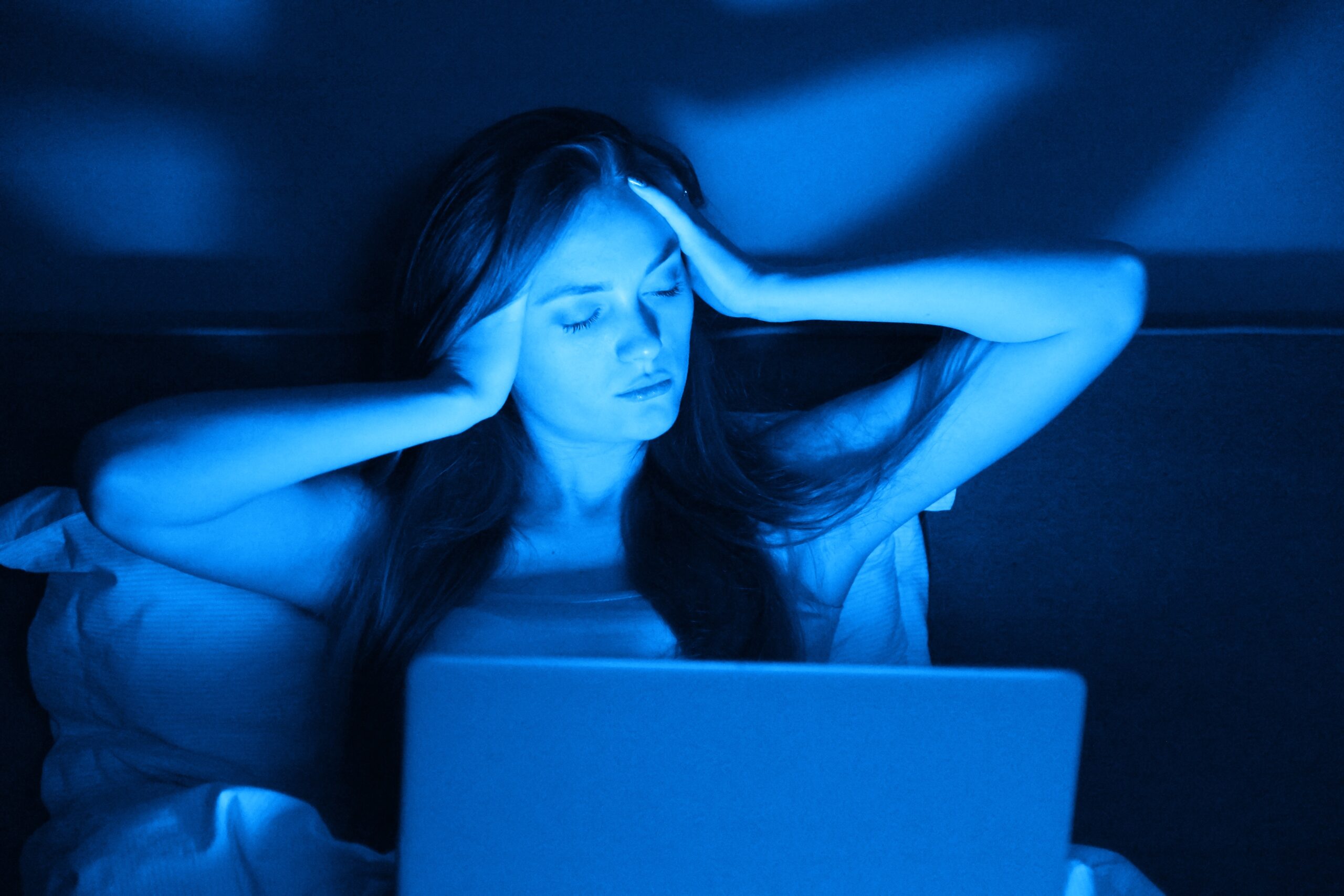
The discovery of melanopsin has revolutionized understanding of how light influences circadian rhythms and mental health. Optimal daytime exposure to bright, natural light activates melanopsin-mediated pathways, promoting phase alignment of the circadian system, enhancing alertness, and supporting emotional stability (Blume et al., 2019). Conversely, insufficient daytime light or excessive nighttime exposure can desynchronize rhythms, leading to chronodisruption. This misalignment is implicated in psychiatric disorders, as ipRGCs project not only to the SCN but also to mood-regulating regions such as the prefrontal cortex and limbic areas (LeGates et al., 2012; Fernandez et al., 2018).
Large-scale objective studies confirm that greater daytime light exposure, which engages melanopsin, is protective against major depressive disorder, post-traumatic stress disorder, and other conditions, while brighter nighttime light exacerbates risks (Burns et al., 2023). Animal models further demonstrate that aberrant light patterns, mediated by melanopsin, can induce depression-like behaviors independent of sleep disruption, highlighting direct effects on mood circuits (LeGates et al., 2012). In humans, variations in the melanopsin gene (OPN4) have been linked to seasonal affective disorder, altered chronotypes, and sleep disorders, suggesting individual differences in light sensitivity contribute to vulnerability (Lucio-Enríquez et al., 2025; Roecklein et al., 2013).
Thus, melanopsin serves as a critical link between environmental light and mental health outcomes. Optimizing light exposure to align with melanopsin’s sensitivity—maximizing blue-enriched daylight and minimizing blue-rich artificial light at night—offers a promising, non-invasive strategy for normalizing circadian rhythms and alleviating symptoms of mood and psychiatric disorders.
Click here to download a white paper on light and mental health
References (updated with additions for this section; integrate into full paper’s reference list)
Berson, D. M., Dunn, F. A., & Takao, M. (2002). Phototransduction by retinal ganglion cells that set the circadian clock. Science, 295(5557), 1070–1073. https://doi.org/10.1126/science.1067262
Burns, A. C., Windred, D. P., Rutter, M. K., Olivier, P., Vetter, C., Saxena, R., Lane, J. M., & Cain, S. W. (2023). Day and night light exposure are associated with psychiatric disorders: An objective light study in >85,000 people. Nature Mental Health, 1(11), 853–862. https://doi.org/10.1038/s44220-023-00135-8
Fernandez, D. C., Fogerson, P. M., Lazzerini Ospri, L., Thomsen, M. B., Layne, R. M., Severin, D., Zhan, J., Demas, J. N., Mu, Y., Leake, B., & Hattar, S. (2018). Light affects mood and learning through distinct retina-brain pathways. Cell, 175(1), 71–84.e18. https://doi.org/10.1016/j.cell.2018.08.004
LeGates, T. A., Fernandez, D. C., & Hattar, S. (2012). Light as a mood-manipulator: A review of light therapy in affective disorders. Annual Review of Neuroscience, 35, 539–556. https://doi.org/10.1146/annurev-neuro-072116-031324
Lucio-Enríquez, K. R., Rubio-Valles, M., Ramos-Jiménez, A., & Pérez-León, J. A. (2025). Human melanopsin (OPN4) gene polymorphisms: A systematic review. Frontiers in Neuroscience, 19, Article 1581266. https://doi.org/10.3389/fnins.2025.1581266
Provencio, I., Rodriguez, I. R., Jiang, G., Hayes, W. P., Moreira, E. F., & Rollag, M. D. (2000). A human opsin in the inner retina. Journal of Neuroscience, 20(2), 600–605. https://doi.org/10.1523/JNEUROSCI.20-02-00600.2000
Roecklein, K. A., Wong, P. M., Miller, M. A., Donofry, S. D., Kamarck, M. L., & Brainard, G. C. (2013). Melanopsin, photosensitive ganglion cells, and seasonal affective disorder. Neuroscience & Biobehavioral Reviews, 37(3), 229–239. https://doi.org/10.1016/j.neubiorev.2012.12.009